Professionals from these organizations have trained in TQ


Transactional Intelligence® (TQ) Skillfully navigating exchanges with others.
Transacting isn’t cold. Low TQ is.
Professionals from these organizations have trained in TQ

These Aren’t People Problems.
They’re TQ Problems.
And TQ Problems Have Solutions.
TQ is skillfully navigating exchanges with others.
Nearly everything you want in your professional life comes through an exchange with another person: the deal, the promotion, the partnership, the decision that finally gets made. TQ is the name for how skillfully you navigate those exchanges. Some people do it with precision. Most were never shown how.
TQ is short for Transactional Intelligence®, a structured methodology for seeing the layer beneath your conversations, where agreements are actually made, stalled, or lost.
You’ve likely heard of IQ, the intelligence of thinking, and EQ, the intelligence of emotions. Both are personal traits, qualities you carry with you. TQ is different: it’s found in the exchange between people. That is why no amount of expertise or self-awareness closes the gap on its own.
High TQ closes that gap.
TQ identifies four characteristic ways of moving through the Transaction Cycle™. The Diagnostic locates you within that methodology — not as a final verdict, as a starting point.

Your TQ orientation
Where attention and energy naturally flow in any consequential exchange.
Your avoided exchange
The stage in the Transaction Cycle that your pattern tends to sidestep.
The name of your loop
The specific breakdown pattern your orientation produces under pressure.
A first signal
What the cycle tends to require from you that you are not yet providing.
Free · No prerequisites · Five minutes
The Diagnostic gives you your orientation. Navigator is where that orientation meets your actual transactions.
Two days, in person. You bring a real transaction — something with real stakes, currently in motion.
You work it in real time, with practitioners doing the same. The methodology meets the room. Things that were abstract become navigable.

Transactional Intelligence® (TQ) is a structured methodology for navigating the hidden layer beneath every conversation — the human exchanges that produce every outcome. TQ makes those exchanges visible, so you can navigate them consciously rather than be ruled by forces you cannot see.
Navigator introduces TQ in practice. FOT is where you study the full methodology — every step, in sequence, applied to the transactions that matter most.
Explore FOT →Why It Matters More Than Expertise
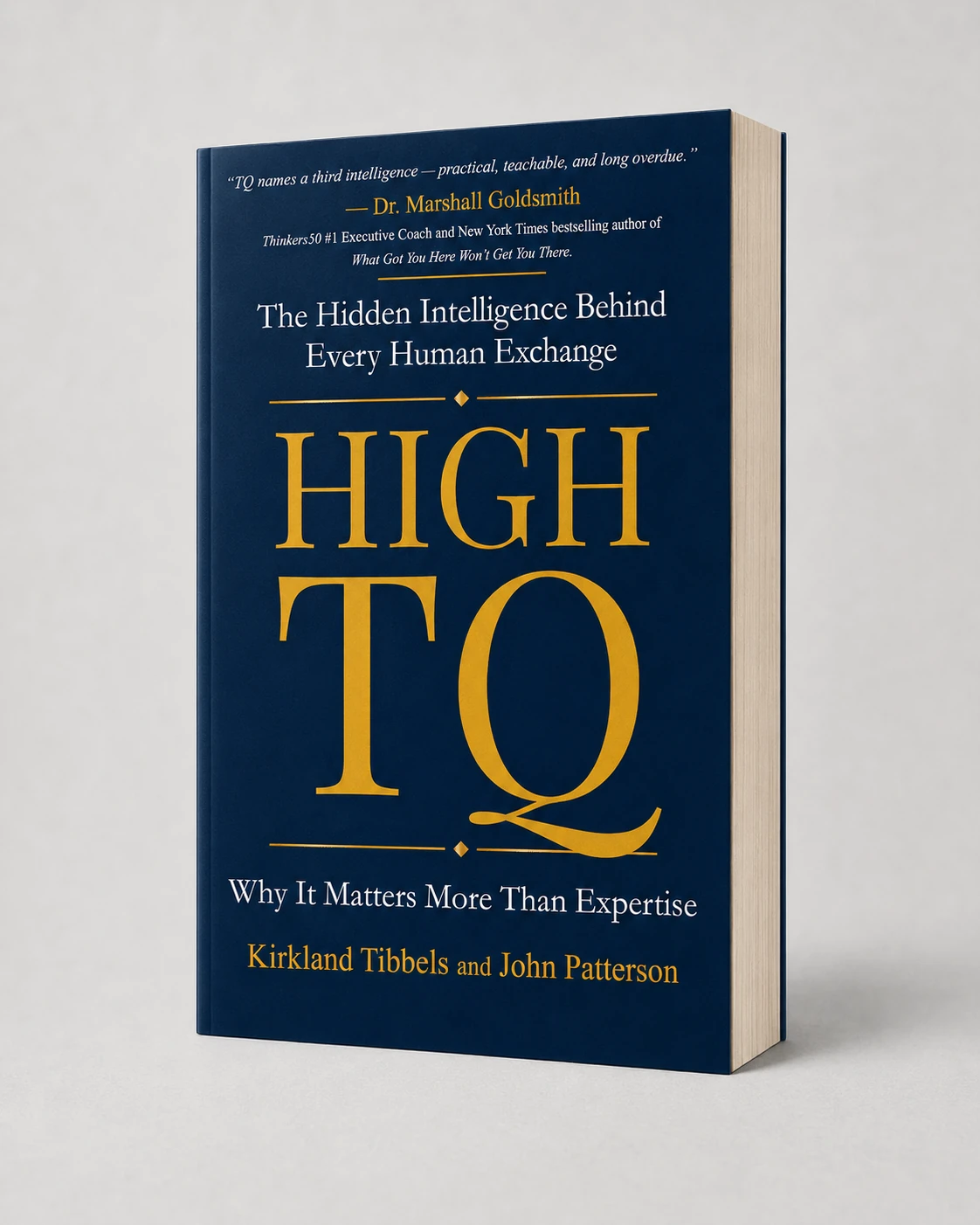
The methodology that drives FOT and Navigator, in book form. For practitioners who want TQ on the page before they attend — or alongside.
Book 1 of the TQ Series. By Kirkland Tibbels and John Patterson.
Available now.
$1.1M
in 7 months.
“We blew through our annual stretch goal of $500K in new revenue to reach $1.1M in just seven months.”
Trisha Tyler · Senior Executive · Colorado
Income
doubled.
“I was able to double my income during my participation in this course.”
Mark Ng · Technology
143%
of goals.
“140% of my health goals, 143% of my financial goals, 25% increase in income.”
Dr. Khush Cooper · CEO · Los Angeles
